Welcome to the first part of Music Theory from Scratch.
We start from the very beginning - it is no problem if you do not know anything about music theory beforehand.
After each part there are exercises you can do. Remember to practice, practice, practice and test what you know!
In this part we will learn the names of all the natural notes (the white keys on the piano).
What is a note?
A note is a sound that has a specific pitch. Notes can be bright (high) or dark (low). They have different characters.
Notes are found everywhere in the sounds around us. A note can be heard from a bee buzzing or a fan humming.
But when you think of notes, most people probably think of notes that come from different instruments.
The important thing to know is that notes have names and that is what we are going to learn now.
We use the piano
We will use a piano to show the notes. Why? Because it is easy to see!
A piano has many keys (the buttons you press). They are either white or black.
Today we focus only on the white keys. The black ones come later!
The piano's secret pattern
Before we learn the note names - look carefully at the piano. Can you see the pattern?

First two black keys that are a little closer together, and then three black keys.
Then we see two black keys again that are a little closer together, and then three black keys. This is a pattern that repeats!
Within each repeating section there are 7 white keys. Those are what we will focus on now - the white keys.
Now let's learn the note names!
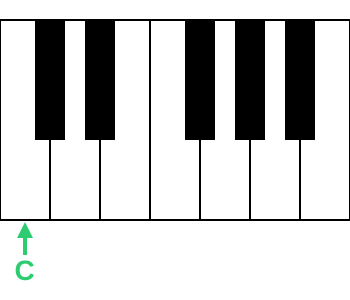
The first white key to the left of the two black keys is called C.
Then we go up through the alphabet:
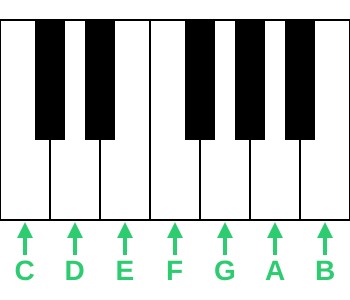
(The note B is sometimes called H in some European music theory traditions. Today B is most commonly used.)
The pattern repeats - Octaves
After B it starts over again! The next key becomes C again, then D, E, F, G, A, B... and so it continues.
So there are many C's on a piano, many D's, many E's and so on. The notes have the same name, but they sound brighter the further to the right on the piano you play, and darker the further to the left.
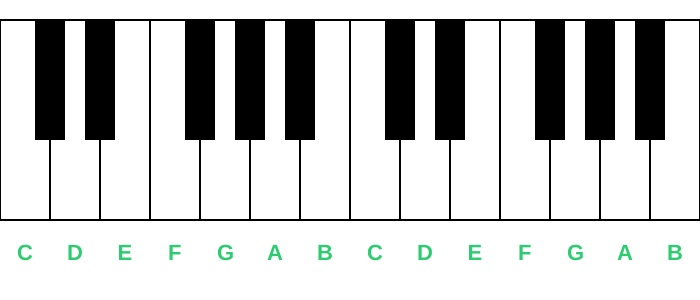
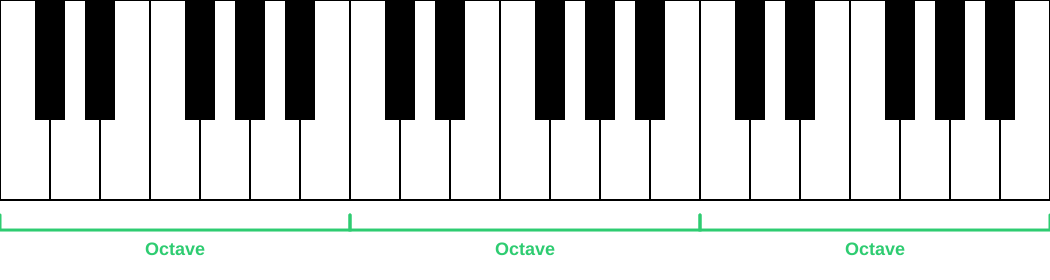
The distance from one note to the next note with the same name is called an octave (for example from C to the next C). An octave consists of eight steps: C, D, E, F, G, A, B, C. So there are seven different note names before the sequence starts over. Notes with the same name in different octaves sound alike, but one is higher or lower than the other.
On the piano, octaves are usually divided from C to C, and each such distance has its own name - so that you can distinguish between, for example, a bright C and a dark C. We will cover that in more detail later in the course.
Frequently asked questions about note names
What are the seven note names in music?
The seven natural notes are C, D, E, F, G, A and B. They are the white keys on the piano, and after B the sequence starts over at C again.
How do you find C on the piano?
C is the white key immediately to the left of a group of two black keys. From C you can find the other notes by going up through the alphabet: C D E F G A B.
Why is B sometimes called H?
In some European music theory traditions the note B is called H. It is the same key on the piano - only the name is different. Today B is the most common name.
How many notes are there in an octave?
An octave has seven different note names on the white keys. Counting from C up to the next C gives eight notes, which is where the word octave comes from. Including the black keys there are twelve keys in each octave.
Want to practice? Try the note names exercise on the piano or take the note names quiz.
Well done!
Now you know the names of all the white keys! (C D E F G A B) But what about the black keys? We will get to those a little later.
Next step: We will learn how to write notes on a music staff.
Ready to practice?