In the previous part we learned the names of all the natural notes: C D E F G A B.
We are going to look at the staff - what you write notes on.
Why do we need written music?
Imagine that you have come up with a beautiful melody. You want to remember it, and you want a friend to be able to play it too. How do you do that?
You can write music down in a special way called music notation. It is like a language - when you can read it you can play music that someone else has written, even if you have never heard it before!
But in order to write down notes we need something to write on. Just as we write text on lines in a notebook, we write notes on a staff.
The Staff
A staff consists of five lines and four spaces (the areas between the lines).

This is the foundation of all music notation. On these lines and spaces we then place notes.
A note is placed either on one of the lines, or between two lines (in a space).
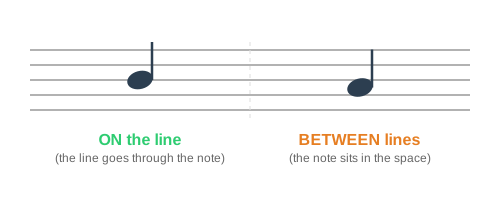
The higher up on the staff a note is placed, the brighter (higher) the pitch sounds. The lower down, the darker (lower) it sounds.
How do we know what the notes are called?
To know what the notes are called we need a symbol at the beginning of the staff. That symbol is called a clef.
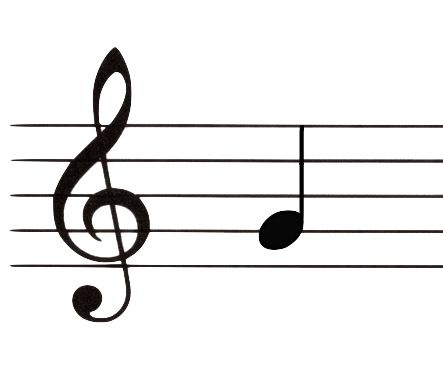
The clef we use here is called the treble clef. It shows where the note G is located on the staff.
The treble clef curls around the second line from the bottom. That is how we know that a note on that line is G.
When we know where G is we can find the other notes by going step by step in the order of the notes.
Do you remember the order of the notes from the previous part? C D E F G A B. After B it starts over at C again.
G
on line 2 from the bottom
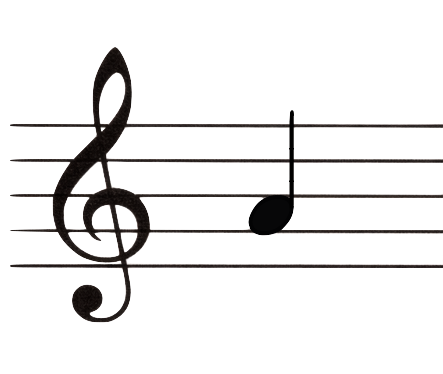
A
in the space above
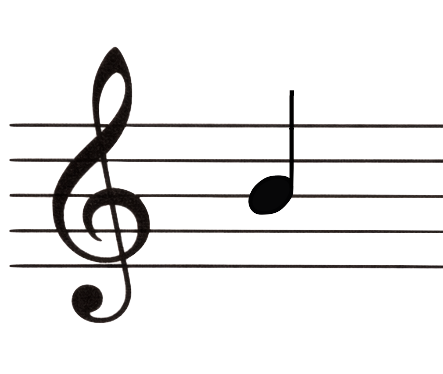
B
on the next line
When we go one step up from G we get A. The note then lands in the space above.
If we go one more step we get B, which lands on the next line.
Question: If G is on the second line from the bottom, which note is one step up, in the space above G?
Show answer
Answer: A. A comes right after G in the order of notes. Therefore A is in the space above G.
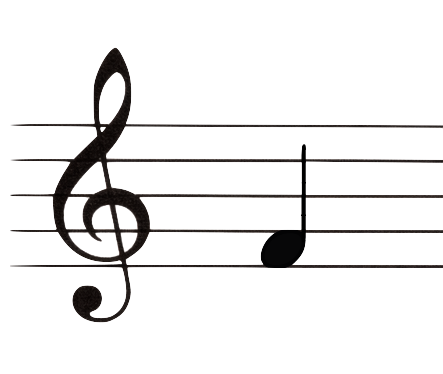
Question: If G is on the second line from the bottom, which note is one step down, in the space below G?
Show answer
Answer: F. F comes right before G in the order of notes. Therefore F is in the space below G.
The notes' positions on the staff
Now we know how to find the notes by going step by step. Here you can see all the notes from C to B together:
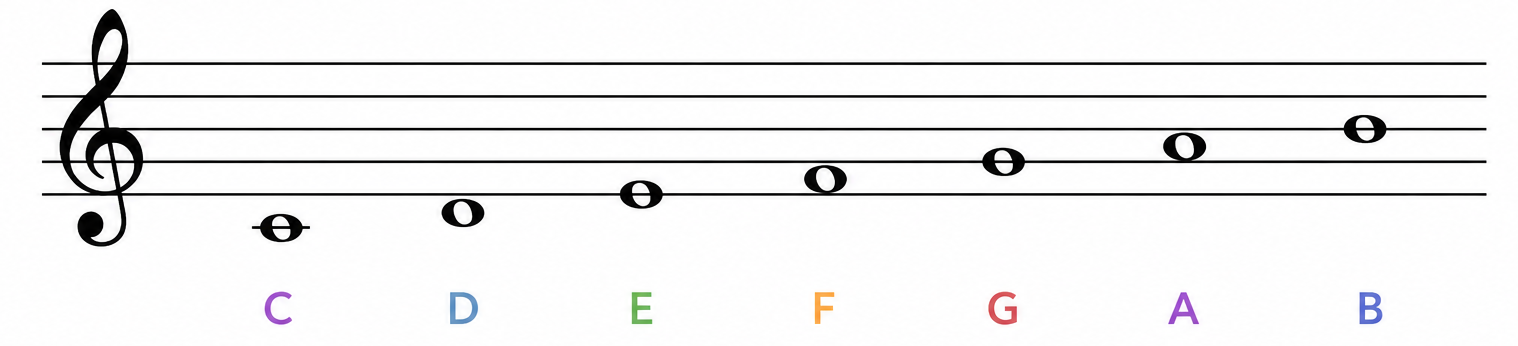
Can you see the pattern? When we go step by step through the notes, the notes also move step by step on the staff. They alternate between being on a line or between two lines, and the pattern continues even outside the five lines.
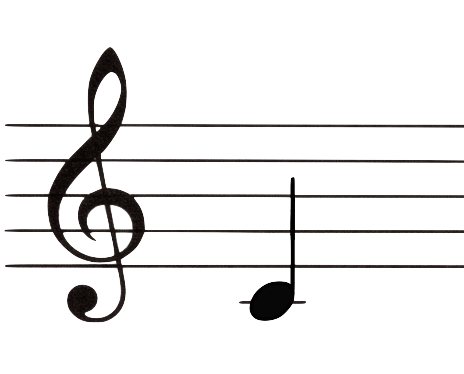
Notice that C sits just below the staff, on a small extra line. This is called a ledger line. We will learn more about ledger lines in the next part.
Good to know: The notes we have looked at belong to the one-line octave. We will learn more about what octaves are in Part 4.
Frequently asked questions about the staff and the treble clef
How many lines does a music staff have?
A staff has five lines and four spaces. Notes are placed either on a line or in a space between two lines, and the higher a note sits, the higher it sounds.
Where is G in the treble clef?
The treble clef curls around the second line from the bottom, and a note on that line is G. That is why the treble clef is also called the G clef.
How do you remember the notes in the treble clef?
The lines from the bottom up are E, G, B, D and F - often remembered as "Every Good Boy Does Fine". The spaces from the bottom up spell F, A, C, E.
Where is middle C in the treble clef?
Middle C (C in the one-line octave) sits just below the staff on a short extra line called a ledger line.
Practice what you have learned in the note reading exercise in treble clef.
Well done!
Now you know the basics of the staff! You know that it has five lines and four spaces and that notes can be placed both on lines and between them.
You have also seen how the treble clef shows where the note G is, and how the notes are placed step by step on lines and in spaces.
You do not need to know all the note positions by heart yet - that will come with practice!
Ready to practice?