You have learned that notes can be raised and lowered with ♯ (sharp) and ♭ (flat), and that different keys can use different raised or lowered notes. In G major, for example, we always raise F to F♯.
But what if you are going to play an entire piece in G major, where the note F comes up again and again? Do you really have to write a ♯ before every single F? That quickly gets messy - both to write and to read.
Key signatures
Instead of writing ♯ before every F, we can write a ♯ at the start of every line of music, right after the clef.
Without a key signature
Every F needs its own ♯.
With a key signature
One ♯ after the clef is enough - it applies to every F.
The sharp at the start tells you that every F should be played as F♯, unless stated otherwise. Accidentals written this way at the start of the staff are called a key signature.
So in G major, F♯ is part of the key signature.
A key signature applies:
- from the start of the piece
- in every octave
- until the key or the key signature changes
Different keys have different key signatures
C major needs no key signature:
C - D - E - F - G - A - B - C
G major needs one:
G - A - B - C - D - E - F♯ - G
If we build D major, we get:
D - E - F♯ - G - A - B - C♯ - D
So D major needs two sharps: F♯ and C♯.
F major goes the other way and needs a flat:
F - G - A - B♭ - C - D - E - F
So in F major, B♭ is part of the key signature.
More flats work the same way. B♭ major, for example, has two: B♭ and E♭.
B♭ - C - D - E♭ - F - G - A - B♭
Major and minor can share the same key signature
You have already seen that C major and A minor are relative keys because they contain the same notes.
Because they contain the same notes, they also have the same key signature.
C major ↔ A minor
No key signature
G major ↔ E minor
F♯
F major ↔ D minor
B♭
How to find the relative key
You don't need to memorize which major and minor keys go together. You can find the relative key by counting half steps.
If you know the major key and want to find the minor key:
Go three half steps down from the major key's root note.
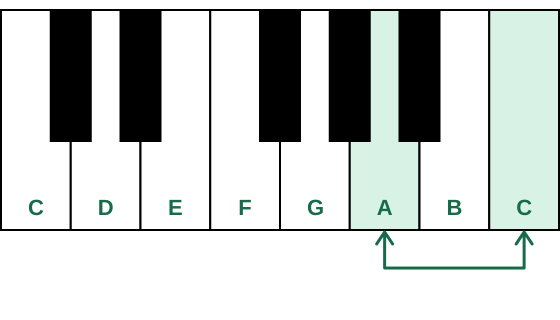
Three half steps down from C is A. That is why A minor is the relative minor of C major.
The same thing works the other way too! Want to go from minor to major?
Then do the opposite and go three half steps up. From A you land on C. So C major is the relative major of A minor.
Test yourself
1. A piece has a ♯ on F as its key signature. What does that mean?
Show answer
Answer: Every F is played as F♯, unless stated otherwise.
2. Which major key has this as its key signature?
Show answer
Answer: D major.
3. Which minor key is the relative minor of G major?
Show answer
Answer: E minor. Go three half steps down from G.
4. A minor has no key signature. Which relative major key does it have?
Show answer
Answer: C major. Go three half steps up from A.
Remember
- A key signature is written at the start of the staff line, after the clef.
- It shows which notes should be raised or lowered throughout the piece.
- Different keys have different key signatures.
- Relative keys are a major key and a minor key that contain the same notes and therefore have the same key signature.
- From major to relative minor: go three half steps down. From minor to relative major: go three half steps up.
Next step
But is there a way to keep track of all the keys and their key signatures?
You'll find out in the next part.