In the previous course you learned that a sharp raises a note by a half step and that a flat lowers a note by a half step.
Now we will take a closer look at the distance between notes. You need to know this to understand how scales and keys are built.
The distance between notes
The distance between two notes can be described in half steps and whole steps. On the piano it is easy to see the distances between notes.
Half step
A half step is the smallest distance between two notes on the piano.
On the piano you move a half step when you go from one key to the key right next to it - whether that key is white or black.
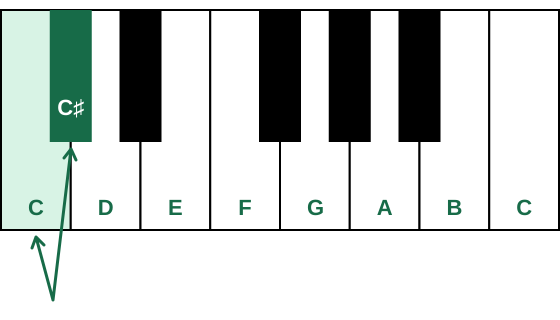
The distance between C and C sharp (C#) is a half step.
E and F are right next to each other on the piano. That is why the distance between them is a half step.
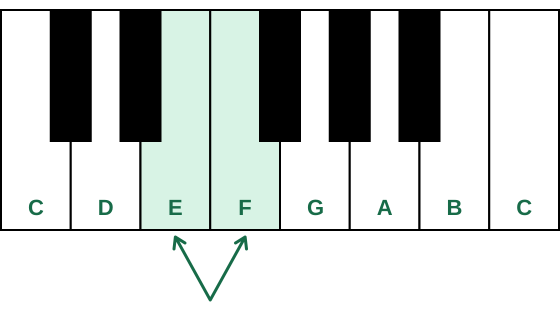
The distance between E and F is a half step.
The same is true between B and C.
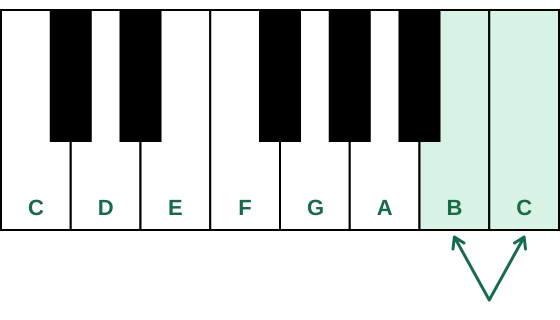
The distance between B and C is a half step.
Question: Is the distance between F and F sharp (F#) a half step or a whole step?
Show answer
Answer: A half step. The keys are right next to each other, with no key between them.
Question: Which note do you land on if you go a half step up from B?
Show answer
Answer: C. B and C are right next to each other on the piano, so the distance is a half step.
Whole step
A whole step consists of two half steps.
On the piano this means there is one key between the starting note and the ending note.
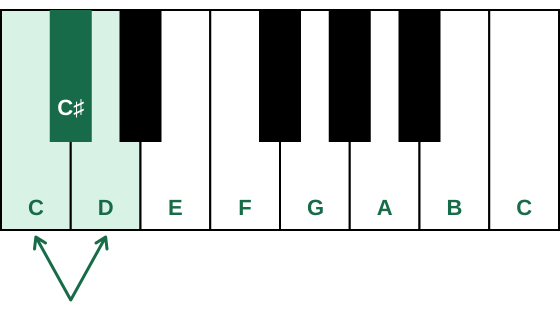
The distance between C and D is a whole step. Between them lies C sharp (C#), so you go two half steps: C → C sharp → D.
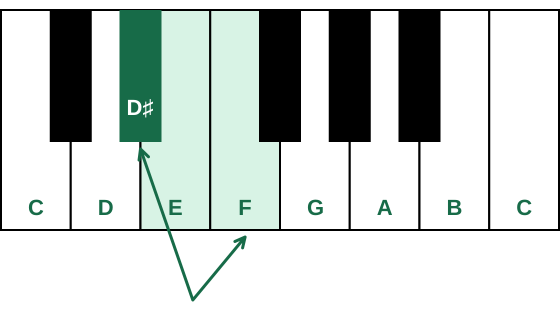
The distance between D sharp (D#) and F is a whole step. Between them lies E, so you go two half steps: D sharp → E → F.
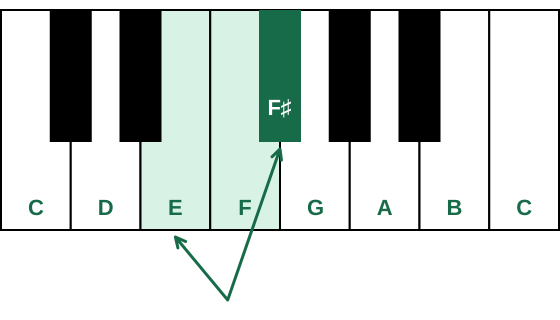
The distance between E and F sharp (F#) is a whole step. Between them lies F, so you go two half steps: E → F → F sharp.
Question: Which note do you land on if you go a whole step up from G?
Show answer
Answer: A. You go two half steps: G → G sharp (G#) → A.
Question: Is the distance between E and F a whole step because both keys are white?
Show answer
Answer: No, it is a half step. A whole step up from E is F sharp (F#): E → F → F sharp. It is the distance, not the color of the keys, that counts.
Why does this matter?
Whole steps and half steps are the building blocks of scales. It is the distances between the notes that determine how a scale sounds and which notes it contains.
Once you understand these distances, you can see how scales are built and why certain notes need to be raised or lowered with a sharp or a flat.
Practice
Try recognizing half steps and whole steps in an interactive exercise.
Practice half steps and whole stepsRemember
- A half step is the distance from one key to the key right next to it.
- A whole step consists of two half steps.
- The color of the keys does not matter - it is the distance between the notes that counts.
- Between E and F, and between B and C, it is a half step because the keys are right next to each other.
Next step
Now you know how whole steps and half steps work. In the next part we will use them to build the major scale.