Now you know note values and rests. The next step is to learn how the beats in music are grouped into measures - and how the time signature shows how each measure should be counted.
Pulse, beats and measures
When you listen to music you can often feel a steady pulse - much like a steady ticking through the music.
Each tick in the pulse is called a beat.
The beats are divided into groups called measures (also known as bars). A measure can contain different numbers of beats. They can for example be counted in groups of four:
1 - 2 - 3 - 4 | 1 - 2 - 3 - 4
or in groups of three:
1 - 2 - 3 | 1 - 2 - 3
Every time the count starts over from 1, a new measure begins.
Bar lines
In sheet music, measures are separated by vertical lines called bar lines.

A bar line is a thin vertical line through the staff. Everything between two bar lines is one measure.
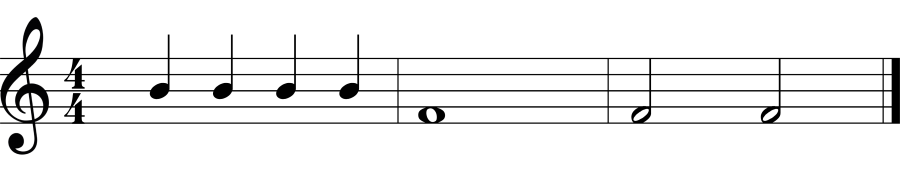
Here you can see three measures. The bar lines show where one measure ends and the next one begins.
What is a time signature?
The time signature shows how many beats there are in each measure and which note value the time signature is based on.
At the beginning of the staff you will see two numbers written one above the other. This is the time signature.

The top number shows how many beats there are in each measure.
The bottom number shows which note value the time signature is based on. The number 4 stands for a quarter note.
In 4/4 there are four beats in each measure, and a quarter note equals one beat.
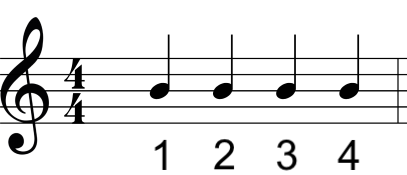
Notes and rests work together to fill the measure. In 4/4 their combined length must equal four quarter notes. A measure can therefore be filled in different ways:
- Four quarter notes - each note lasts one beat
- One whole note - lasts four beats and fills the entire measure
- Two half notes - each note lasts two beats
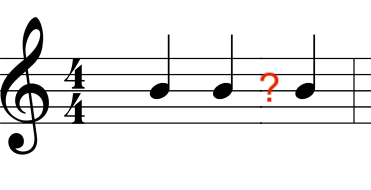
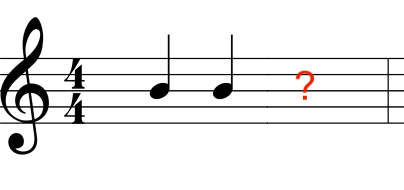
Which rest is needed to fill the measure?
Count how many beats are already filled. How much is missing?
Show answer
A quarter rest. The three quarter notes fill three beats, so one beat is missing - a quarter rest.
Show answer
A half rest. The two quarter notes fill two beats, so two beats are missing - a half rest.
Other time signatures
Not all measures contain four beats. There are many other time signatures. Here are two common examples.
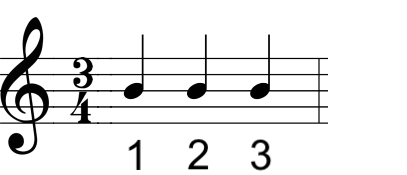
Three-four time (3/4)
In 3/4 there are three beats in each measure, and the quarter note equals one beat.
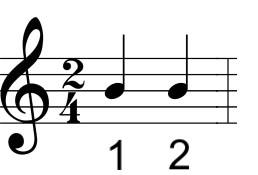
Two-four time (2/4)
In 2/4 there are two beats in each measure, and the quarter note equals one beat.
Listen to the time signature
Want to hear how different time signatures feel in real music? Search for the music examples and try counting along.
4/4 - Zara Larsson: Lush Life
A lot of pop music is in 4/4. Search for Zara Larsson - Lush Life, find the steady pulse and try counting along:
1 - 2 - 3 - 4 | 1 - 2 - 3 - 4
Can you feel how the beats are grouped in fours?
3/4 - Johann Strauss II: An der schönen blauen Donau
A waltz usually goes in 3/4. Search for An der schönen blauen Donau (The Blue Danube) and try counting along:
1 - 2 - 3 | 1 - 2 - 3
In a waltz the first beat of each measure is often emphasised:
ONE - two - three | ONE - two - three
Can you feel how the beats are grouped in threes?
Frequently asked questions about time signatures
What does 4/4 mean in music?
In 4/4 there are four beats in each measure and a quarter note equals one beat. It is the most common time signature in pop music.
What do the two numbers in a time signature mean?
The top number shows how many beats there are in each measure. The bottom number shows which note value counts as one beat - 4 stands for a quarter note.
What is the difference between 3/4 and 4/4?
In 3/4 each measure has three beats instead of four. It is the typical time signature for a waltz, counted ONE - two - three.
What is a measure in music?
A measure (or bar) is a group of beats between two bar lines. The notes and rests in each measure must together fill the number of beats set by the time signature.
Test yourself with the time signatures quiz.
Well done!
Now you know that beats are grouped into measures, that the time signature shows how the measure should be counted, and that notes and rests together fill each measure.
This was the final part of the course Music Theory from Scratch. If you've completed all the parts, you now have a solid foundation in music theory - congratulations!
Test what you've learned by taking the final exam covering the entire course, or head over to the exercises to practice more.