If you have gone through the earlier parts and done the exercises, you now have a good foundation to build on.
In Part 1 you learned the notes C D E F G A B on the piano's white keys. At that point we left the black keys for later.
Now it is time to find out what they are called - and how we write them with notation.
The black keys
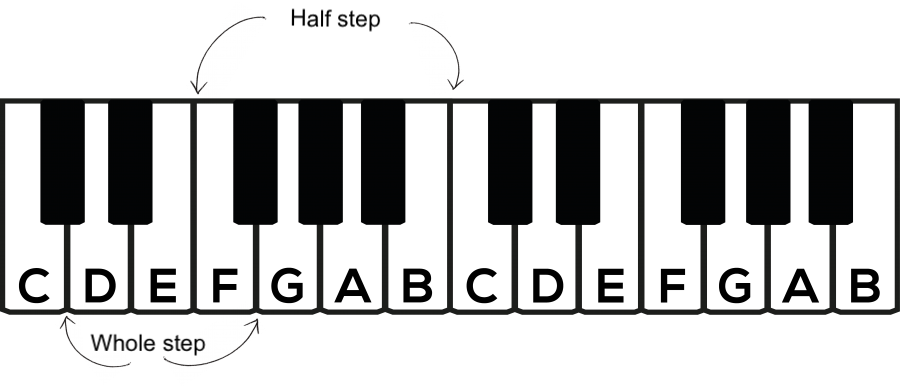
Between most white keys there is a black key. Notice that there is no black key between E and F or between B and C.
The distance from one key to the very next key is a half step (also called a semitone) - regardless of whether the key is white or black.
To raise or lower a note by a half step we use accidentals.
Sharp (#)

A sharp raises the note by a half step.
If we write a sharp before C it becomes C sharp (C#). On the piano we end up on the black key immediately to the right of C.
The black keys can be named with sharps as:
C#, D#, F#, G# and A#
Flat (♭)

A flat lowers the note by a half step.
If we write a flat before D it becomes D flat (D♭). On the piano we end up on the black key immediately to the left of D.
The black keys can be named with flats as:
D♭, E♭, G♭, A♭ and B♭
What happens between E-F and B-C?
There is no black key between E and F or between B and C. But the rule is still the same: a sharp raises the note by a half step and a flat lowers it by a half step.
Therefore:
- E# = F
- F♭ = E
- B# = C
- C♭ = B
So a sharp or flat does not always lead to a black key.
Same key - different names
You may have noticed that C# and D♭ are the same key on the piano.
This is because we can reach the same note in two ways:
- If we raise C by a half step we get C#.
- If we lower D by a half step we get D♭.
The same key can therefore have different names depending on how the note is written.
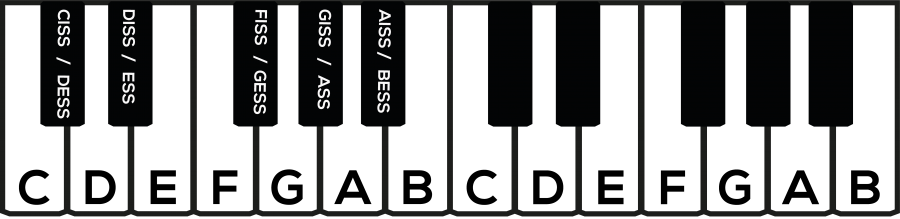
Some examples:
- C# = D♭
- D# = E♭
- F# = G♭
- G# = A♭
- A# = B♭
Natural sign (♮)

A natural sign cancels a previous sharp or flat.
When a sharp or flat is written before a note it applies to the same note in the same octave for the rest of the measure. At the next bar line it ceases to apply.
Frequently asked questions about sharps and flats
What does a sharp do in music?
A sharp (#) raises a note by a half step. C# is played on the black key immediately to the right of C.
What does a flat do in music?
A flat (♭) lowers a note by a half step. D♭ is played on the black key immediately to the left of D.
Is C sharp the same as D flat?
Yes, on the piano C# and D♭ are the same key. The note just has two different names depending on whether you raise C or lower D. Notes like these are called enharmonic equivalents.
How long does a sharp or flat last?
An accidental applies to the same note in the same octave for the rest of the measure. At the next bar line it no longer applies, and a natural sign (♮) can cancel it earlier.
Practice finding sharps and flats on the piano in the piano keys exercise.
Well done!
Now you know that a sharp (#) raises a note by a half step and that a flat (♭) lowers it by a half step.
You also know that the same key on the piano can have different names, for example C# and D♭.
Do you have a good grasp of sharps and flats now?