Now you know where the notes are placed in the staff. But when reading sheet music you also need to know how long each note should be played.
That is what we are going to learn now - note values!
In this lesson we count the quarter note as one beat.
Quarter note
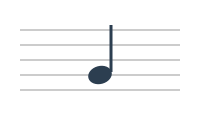
Many people probably recognise this note. It is called a quarter note.
It has a filled note head (solid black) and a stem.
The quarter note lasts for 1 beat.
Half note
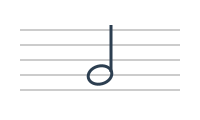
The half note looks almost like a quarter note, but the note head is open (hollow) instead of filled.
The half note lasts for 2 beats.
Whole note
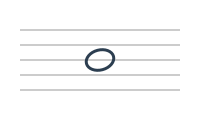
The whole note has an open note head (an oval ring) and no stem.
The whole note lasts for 4 beats.
Eighth note
Now we go the other way - notes that are shorter than a quarter note.
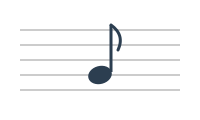
The eighth note looks like a quarter note, but has a flag on the stem.
Two eighth notes fit into one beat.
Sixteenth note
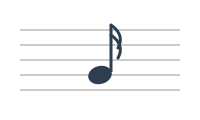
The sixteenth note has two flags on the stem.
Four sixteenth notes fit into one beat.
Listen: which note is it?
Listen and think about which note value it is. Then press "Show answer".
Show answer
Half note - the tone lasts for two beats.
Show answer
Sixteenth note - the tone lasts for a quarter of a beat.
Show answer
Whole note - the tone lasts for four beats.
Show answer
Eighth note - the tone lasts for half a beat.
Show answer
Quarter note - the tone lasts for one beat.
Hear the difference
Press "Listen" to hear how the note values sound compared to each other.
Longer and longer
Shorter and shorter
Try it yourself: clap along!
Exercise: Press "Listen" next to the quarter note above and clap your hands in time with the tone. Each clap = one beat.
Then try eighth notes - now you clap twice as fast, two claps per beat.
Can you manage sixteenth notes? Four claps per beat!
Compare note values
Different note values last for different lengths of time. Here you can see how many shorter notes fit into the same time as one longer note.
Frequently asked questions about note values
How many beats is a whole note?
When the quarter note counts as one beat, a whole note lasts 4 beats, a half note 2 beats and a quarter note 1 beat.
What is the difference between a half note and a quarter note?
Both have a stem, but the half note has an open (hollow) note head and lasts 2 beats, while the quarter note has a filled note head and lasts 1 beat.
How many eighth notes are in a quarter note?
Two eighth notes fit into one quarter note, and four sixteenth notes fit into one quarter note.
How can you tell an eighth note from a sixteenth note?
An eighth note has one flag on the stem and a sixteenth note has two flags. When several are grouped together, the flags are replaced by one or two beams.
Check what you have learned in the note values quiz.
Well done!
Now you know the most common note values and how long they should sound. Remember to practice, practice, practice!
Ready to practice?