You have already encountered octaves in the course - you have practiced notes in the one-line octave, and in the previous part we also saw the small octave in bass clef.
Now we will go through the different octaves and why they have names.
Review: What is an octave?
Do you remember from Part 1? The note names start over after B - the next note becomes C again. The distance from one note to the next note with the same name is called an octave.
C – D – E – F – G – A – B – C
one octave
A piano has several C's, several D's, several E's and so on. Two C's have the same note name, but are at different pitches and therefore sound different.
If someone says "play a C" - which C do they mean? There are several!
That is why notes are divided into different octaves, and each octave has its own name. This way you can distinguish between, for example, a bright C and a dark C.
The octaves on the piano
Each octave stretches from one C to the next C. Here are the most common octaves:
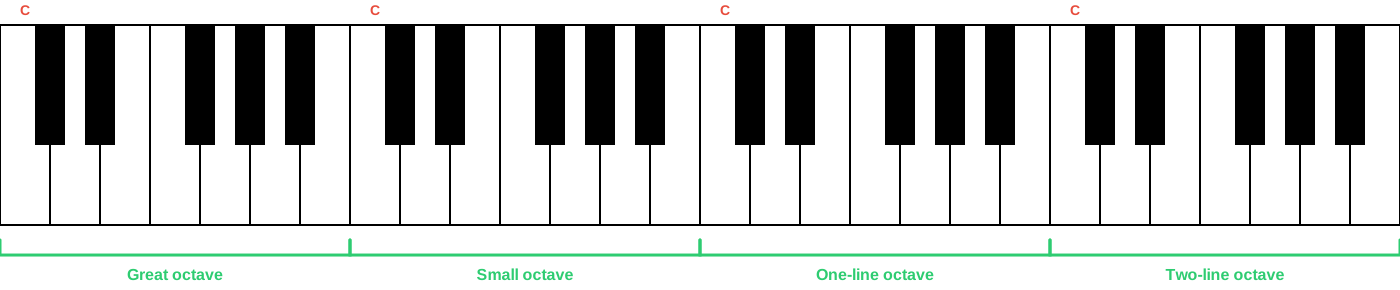
- Great octave
- Small octave
- One-line octave - the one we started with in Part 2
- Two-line octave
There are more octaves beyond these, but these four are the most common ones to start with.
How do you write the notes?
To show which octave a note belongs to, the note name is written in different ways:
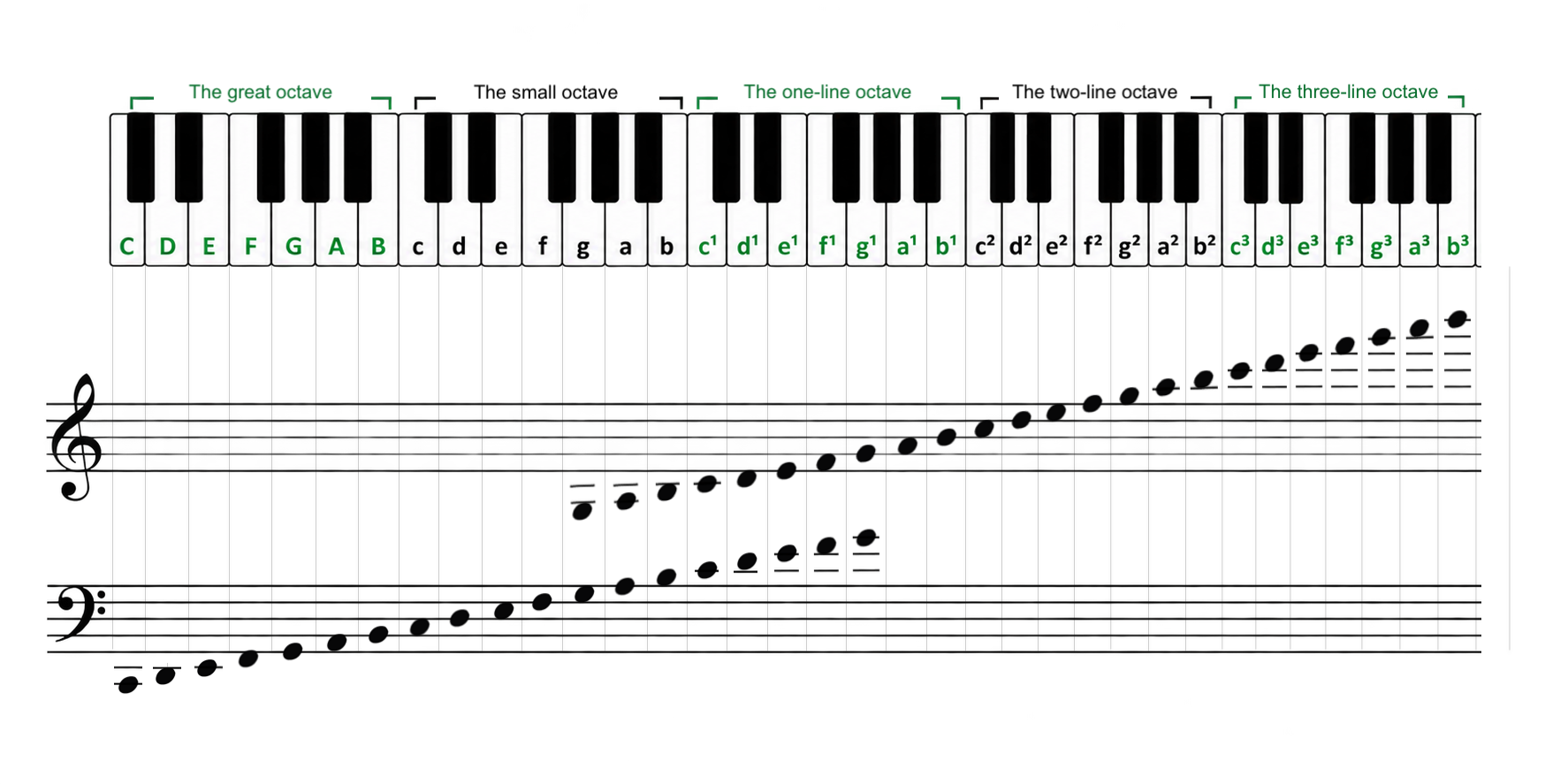
- Great octave - uppercase letters (C, D, E...)
- Small octave - lowercase letters (c, d, e...)
- One-line octave - lowercase letters with a 1 (c1, d1, e1...)
- Two-line octave - lowercase letters with a 2 (c2, d2, e2...)
- Three-line octave - lowercase letters with a 3 (c3, d3, e3...)
Question: If you play a D in the small octave, and then play the same note but one octave higher - in which octave do you end up?
Show answer
Answer: The one-line octave. A D one octave higher still has the note name D, but is in the next octave - the one-line octave.
Frequently asked questions about octaves
What is an octave in music?
An octave is the distance from one note to the next note with the same name, for example from C up to the next C. On the piano an octave spans twelve keys (half steps).
Why do two notes an octave apart sound alike?
The higher note vibrates exactly twice as fast as the lower one. That is why they blend so well and share the same note name, even though one is higher.
What octave is middle C in?
Middle C is the C in the one-line octave and is written c1. It is the C near the middle of the piano, and it sits on a ledger line between the treble clef and the bass clef.
How do you write notes in different octaves?
The great octave uses uppercase letters (C), the small octave lowercase letters (c), and the one-line and two-line octaves lowercase letters with a number (c1, c2).
Practice reading notes in different octaves in the treble clef exercises and the bass clef exercises.
Well done!
Now you know what an octave is, why octaves have names and how to write notes in different octaves. Remember to practice, practice, practice!
Ready to practice?